METHODOLOGICAL PAPER ON THE NATIONAL STATE OF ENVIRONMENT REPORT


Everyone has the right to timely and complete information about the state of the environment and about the causes and consequences of its condition – Article 45 of Constitution of the Slovak Republic

BACKGROUND STORY

BACKGROUND STORY


WHO WE ARE

Slovak Environment Agency (SEA) is a cross-cutting professional organisation of the Ministry of Environment of the Slovak Republic with a national scope.

The SEA is the only cross-cutting professional organisation of the Ministry of Environment of the Slovak Republic focusing on environmental care, environmental development and implementation of environmental policy instruments, operation and creation of information systems for the environment and landscape care in accordance with the principles of sustainable development

The Ministry of the Environment (MoE SR)
was re - established as of 2 November 2010 to function as the central state administrative authority and supreme inspection authority in environmental affairs. To guarantee and inspection activity of the Government of the Slovak Rebuplic, the Ministry of the Environment co-ordinates the activities of all Ministries and other central state administrative authorities of the Slovak Republic in environmental matters.
The European Environment Agency (EEA)
is an agency of the European Union, whose task is to provide sound, independent information on the environment. The EEA aims to support sustainable development by helping to achieve significant and measurable improvement in Europe's environment, through the provision of timely, targeted, relevant and reliable information to policymaking agents and the public.

WHAT WE DO TOGETHER

ENI SEIS II. - EAST Sharing of Slovak Eionet expertise and knowledge on environmental assessments under ENI SEIS II East project

This project is set in the context of the Eastern Partnership Initiative that aims to deepen the EU's relations with the six Eastern Partnership Countries, supporting the promotion of environmental protection by strengthening environmental governance. The main objective of the project is to continue to implement the principles and practices of the Shared Environmental Information System (SEIS).

You will find more information at project website - https://eni-seis.eionet.europa.eu/east.

STEP BY STEP


Objective: Elaboration of SOER structure proposal – list of chapters, their categorization, methodological approach of the creation of chapters content. Defining the scope of chapters.
Output: Proposal of SOER structure, breakdown of chapters and their scope

Before designing the SOER structure, it is necessary to define the objective of the report and the target groups to which the report will be addressed. Depending on the objective and target groups, the structure of the report may also change. The SOER structure proposal should be prepared by the organisation responsible for the SOER proposal in accordance with the SOER content requirements defined in the relevant international and national regulations. At the same time, the frequency, form and date of publication of the report should be determined.

Example for Slovakia:

Examples of defining SOER structure requirements – international/national level

Each Party shall publish and disseminate, at regular intervals not exceeding three or four years, a national report on the state of the environment, including information on the quality of the environment and information on adverse environmental effects.

Convention on access to information, public participation in decision-making and access to justice in environmental matters (Aarhus Convention).

Reports on the state of the environment shall contain in particular data on the state of the environment and on the causes and consequences thereof, as well as on trends in its development and on measures to protect and improve the environment, including international cooperation.

Law no. 205/2004 Coll. on the collection, storage and dissemination of environmental information and on amendments to certain laws.

In 2016, based on the evaluation of needs and experience associated with publishing reports on the state of the environment, the mechanism for developing SOER was modified in Slovakia. A system of annual and four-year reporting has been introduced (extended version, the one-year report will not be published in the year of publication of the four-year report), the content and scope of annual and four-year reports were differentiated, as well as their form (annual – printed + PDF + on-line version on the web, four-year – printed + interactive version on the web), as well as the language version of the reports (one-year – Slovak, four-year - Slovak + English).

An example of the structure of the Report on the State of the Environment of the Slovak Republic is given in Annex no. 1 (1 A – One-year report structure, 1 B – Extended four-year report structure)

The proposal for the breakdown and content of the SOER chapters is to take into account the related national and international regulations and documents setting out the objectives in each area, information obligations, data and information collection and evaluation flows. When creating chapters it is necessary to adhere to the following principles: to design evaluations in a user-friendly form i. e. to present the topic in the most comprehensible form, to use graphical elements for easier understanding; evaluate the area clearly, unambiguously, with the most up-to-date information; to evaluate the area in a targeted and concrete way – state, development, achievement of objectives, direction towards objectives as well as to compare the national situation with other countries.

The proposal for a breakdown of the chapter should allow for rapid information on substantive findings and, if interested, more detailed information. In order to unify the chapters, it is necessary to define the time period to be evaluated in the SOER. At the same time, the depth of elaboration of evaluations and information within the individual chapters should be harmonised. It is recommended to use indicators in the SOER for assessments that are defined in an international context.

The breakdown of the chapter must be logical and clear. It is advisable to start the chapter by summarising the essential findings as the basic output of the evaluation, for quick orientation of the reader. Subsequently, in order to obtain more detailed information, it is appropriate to provide a more detailed assessment with more detailed data and information. For consistency, a uniform breakdown across all chapters of the report should be used.

Example for Slovakia:

Chapter breakdown example:

Key questions and key findings – Defining issues relevant to the state (last available year) and developments (longer term, year-on-year comparison) of the area considered in relation to the defined objectives. Answering them descriptively without using specific figures. This part of the chapter provides a summary picture of the state and development, with a more detailed description in the following chapter.

Objectives defined in the documents and legislation adopted – Summary of objectives relevant to the area considered (if any)

Detailed assessment of the state and development in the assessed area – Descriptive textual, numerical and graphical assessment of the state and development in the assessed area, including international comparison in selected indicators.

It is necessary to agree on the overall scope of the SOER, defining the number of pages per chapter according to its content, so that the individual chapters are balanced. Given that a wider team of experts is involved in the creation of the SOER, it is necessary that they have the specified scope at the beginning of the work and prepare the relevant documents accordingly.

Example for Slovakia:

SOER scope example:

In the case of the Slovak SOER the total scope of the report is about 220 pages, of which e. g. the summary assessment is made up of 10 pages, the environmental assessment section has a range of approximately 50 pages, and the environmental impact of economic sectors also includes approximately 50 pages.
Objective: Discuss the draft SOER structure, breakdown of chapters, scope and other issues related to the publication of SOER with the target groups concerned.
Output: Final version of SOER structure, breakdown of chapters and their scope

Given the cross-cutting nature and objective of the SOER, feedback on the proposal of the structure should be obtained, as well as opinions, comments, complementary suggestions from various target groups (representatives of the relevant departments and organisations, self-governing bodies, universities, NGOs, the public). In addition to its structure, the consultation process may also cover other areas related to the preparation, publication and distribution of SOER (e. g. form of publication, form of presentation of findings, promotion of results, etc.). The feedback received must be subject to expert judgement by the institution responsible for the publication of the SOER in terms of its suitability, feasibility and compliance with the SOER objective. The process results in a final version of the report structure.

Example for Slovakia:

Example of implementation of the consultation process:

Interested parties workshop with moderated round table discussion. For discussion, questions are prepared in advance and sent out to the participants, in order for them to have time to prepare their views. The space is also given to other questions that may arise during the discussion.

Examples of questions to discuss the content and scope of SOER:

  • Do you consider the proposed content satisfactory? What possible changes to chapters (addition, omission, merger, rearrangement) would you propose and for what reason?
  • In relation to the mentioned structure of chapters, do you think it is sufficient or do you have any suggestions for its modification/improvement?
  • Based on your knowledge and experience with SOER, is the depth of information provided satisfactory? What type of information do you miss? What and for what reason do you recommend to change or adjust. For what purposes do you use SOER and does it have any implications for SOER content change?
  • What is your opinion – what should be the optimal scope of SOER?

Examples of questions to discuss other areas relevant to the SOER preparation, publication and distribution process:

  • What is your opinion on the drafting of an overview of the findings of the Report in terms of the content and form of its presentation?
  • What do you think about adding a summary for policy makers?
  • What would you recommend to the creators of the Report in relation to the form of presentation of findings used as well as overall in relation to the selected form of the Report publication?
  • Could you specify this with regard to the individual target groups of the Report – experts, the general public, policy makers, politicians?
  • What forms of distribution of SOER publishing information would you recommend in order to inform as wide a range of subjects as possible, including the general public?
Objective: In relation to the approved report structure, processing requests for data and information for their owners.
Output: List of data and information requests in a structured form.

The responsible organisation's team for processing the relevant chapters needs data and information the acquisition and processing of which are/may be the responsibility of organisations under the responsibility of the central body responsible for environmental care, but also under the responsibility of other bodies (depending on the organisation in each country) as well as statistical authorities. Obtaining this data and information is much easier when there is a document that imposes obligations to provide it for SOER (either legislation, inter-ministerial agreements, methodological procedure for SOER preparation approved by the government, etc.). It is also necessary to enter a date for submitting the required data and information by the provider.

Example for Slovakia:

An example of a possible form of defining the obligation to provide information:

The Ministry of the Environment of the Slovak Republic (MoE SR) will publish SOER in the Slovak Republic for each year. The competent central state administration authorities of the Slovak Republic shall provide it with supporting documents. The SOER will be issued by the MoE by 15 December of the following year. The competent central authorities shall provide supporting documents by 31 August of the following year.

Law no. 17/1992 on the environment

To unambiguously define and understand data and information requests, it is appropriate to clearly define the requests by the responsible organisation. It is necessary to choose an unambiguous form of their definition (forms of pre-filled tables, or web applications with predefined content and scope of requests, etc.). In order to facilitate further communication, it is advisable to ask the provider to designate a contact person. The availability of data and information should be taken into account when defining requests. Identifying a set of data that is not currently available but which would be needed to describe and evaluate new environmental problems and challenges can help to prioritise the need for future data.

Example for Slovakia:

An example of a form of data and information request:

Request for the Water Research Institute  – Chapter Water – Water pipelines and Sewage sub-chapter


Provision of maps:


map: Percentage of population supplied with water pipelines in 2018


map: Percentage of population connected to public sewerage in 2018


(maps in * jpg, * gif format)  


Provision of data:


Water discharged through public sewerage system (under Water and Sewerage companies and municipal administration) – cleaned


Year

in total

sewage

industrial and other

precipitation

others


(thous.m3.year-1)

(thous.m3.year-1)

(thous.m3.year-1)

(thous.m3.year-1)


2018


Water discharged through public sewerage system (under Water and Sewerage and municipal administration) – uncleaned


Year

in total

sewage

industrial and other

precipitation

others


(thous.m3.year-1)

(thous.m3.year-1)

(thous.m3.year-1)

(thous.m3.year-1)


2018


Objective: Summarising the data and information provided based on a defined request.
Output: A collection of data and information needed to drawn up a SOER

It is necessary to revise the supplied data and information in terms of their completeness, relevance, reliability and quality. If the data is not completely delivered in accordance with the request, communication with the designated contact person is necessary in order to complete it or consult it in case of e. g. some figure is missing, without explaining the reason, differs significantly from the previous period.

The database used to prepare the SOER is extensive. To simplify the processing of collected data, we recommend using/creating a database system – environmental database i. e. a programme, which aims to concentrate data in one place in a structured form, archive entire time series as well as to simplify access to data for the entire team, which greatly streamlines the entire process of their processing. Creating an environmental database will enable the development of client applications not only for the collection, editing and presentation of relevant data, indicators and reports, but also for the unification of its outputs.

Example for Slovakia:

Example of storing and processing environmental data

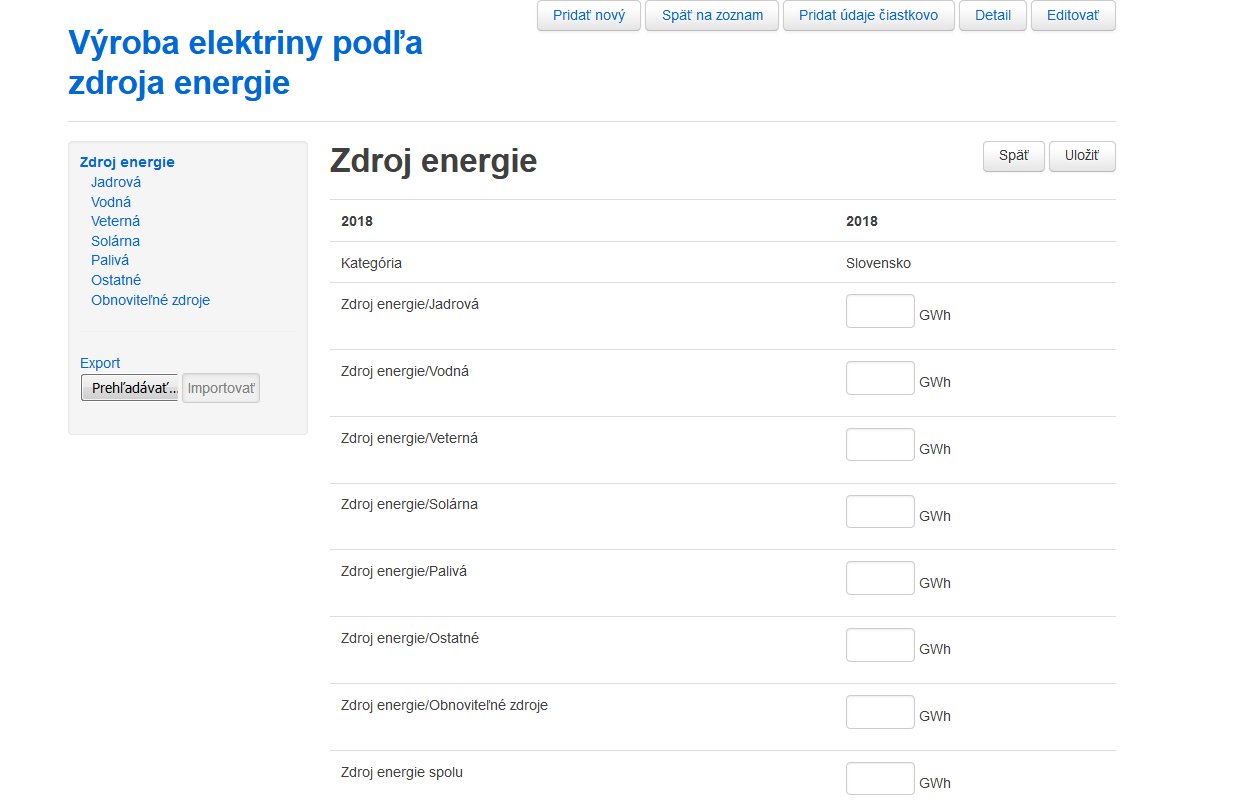
In order to simplify and streamline the process of environmental data processing and to ensure a more user-friendly environment with an extended offer for the presentation of information, the Indicator Information System (ISI) is used in the Slovak Republic. It serves as a database of environmental data and at the same time as a tool for creating uniform outputs from it (graphs, indicators, SOER report, other types of reports). The data entered into the system once is then used to create different communication outputs for different purposes. It also allows data and indicators to be shared internationally.

An example of an ISI workspace for data entry

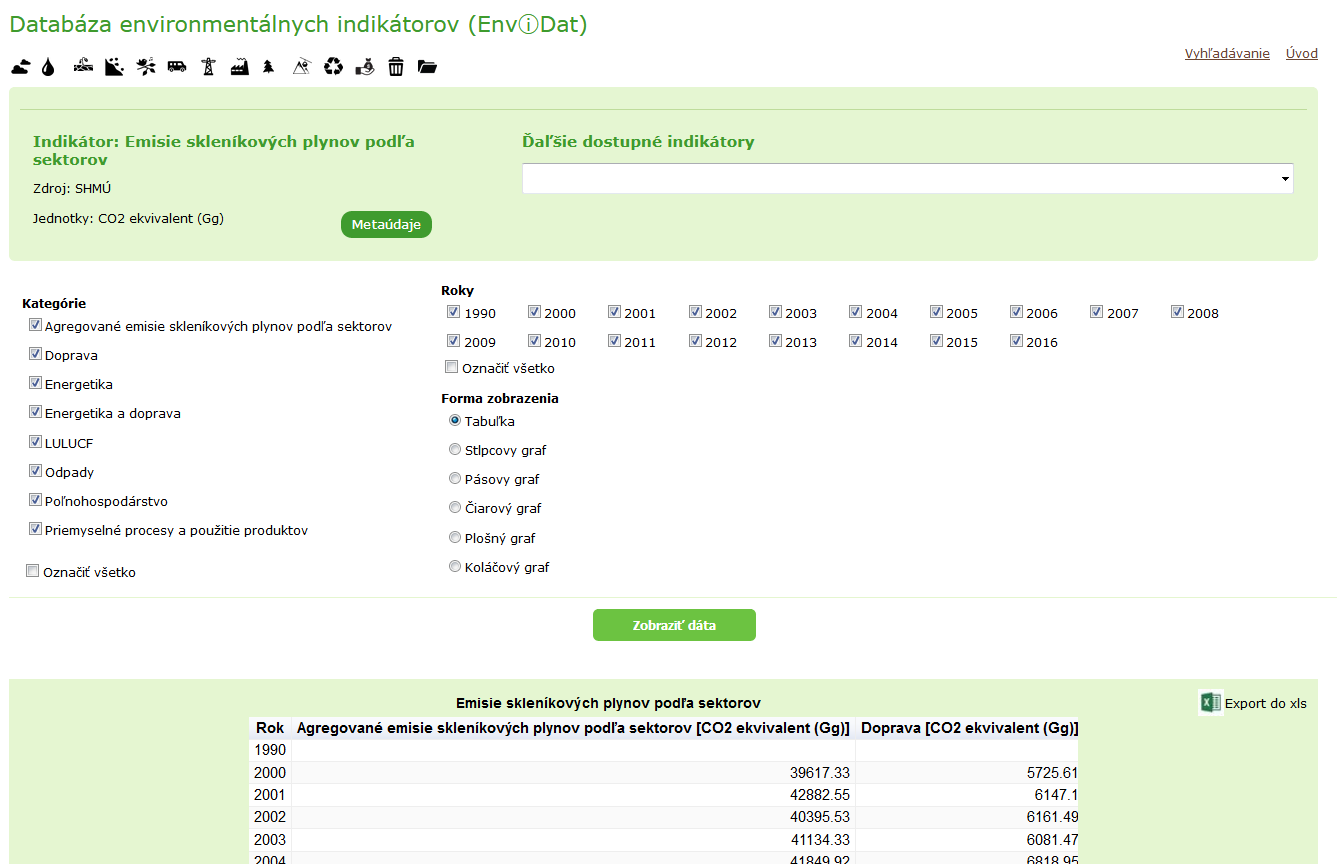
One of the ISI client applications is the EnvⓘDat database, which aims to make available specific database data used for creating reports and environmental indicators to the public. The EnvⓘDat database contains data provided to the Slovak Environmental Agency (SEA) by the relevant organisations listed as a source for processing the SOER published annually. The data are structured as available time series of environmental indicators and environmental related indicators for the Slovak Republic, or their international comparisons and are organised by topic. They can be presented in the form of tables or selected graph types. Data are updated annually following the official data acquisition, usually in Q4 of the year (data for the previous year). After entering the database, the user can select a thematic area, an indicator, a specific category, a time series, an output form as well as an export format.


Example of EnvⓘDat database output

Objective: Textual and graphical processing of SOER according to the agreed structure and structuring by the research team in accordance with the agreed methodology
Output: First SOER proposal

Before processing the received data and information, it is advisable to agree on the form of their processing and presentation of the results. It is necessary to unify whether e. g. SOER will include specific numeric tables or only processed outputs in the form of graphs and maps, which are more readable for the public. From the point of view of graphical presentation it is also useful to define how the graphs should look at the beginning of work. Consideration should also be given to the inclusion and form of a summary assessment of the main findings in order to quickly orientate themselves in the results presented in the SOER.

Example for Slovakia:

The SOER has undergone many changes since its inception (the first issue of the SOER was in 1992-1993), not only in terms of content but also in the methodology of creating chapters and in the form of disclosure. Gradually, the publication of spreadsheets has been abandoned and these have been replaced mainly by presentation in the form of graphs, maps, and the use of infographics has also been gradually increasing The main aim of these changes was to simplify and make the form of information provided more attractive and to make it easier to understand for the target groups, who are not explicitly experts dealing with environmental issues.

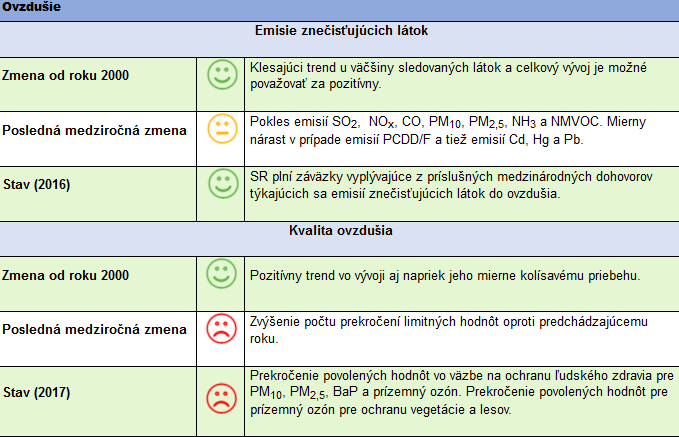
Gradually, key questions and key findings as well as summary assessments have been added to the reports, in preparation of which various forms have been used.

Example of how to create a summary assessment:

SOER in 2016, 2017 – assessment based on a defined methodology using infographics

It is very important to correctly set up the team. It should consist of experienced experts who are knowledgeable in the sub-themes addressed in the SOER and can be expert partners to bodies and organisations that work together to prepare the SOER. The role of the coordinator is important, who is responsible for coordinating the team, the final SOER proposal, its balance and interconnection of chapters.

Objective: Ensure that the proposal is sent for comment procedure after its quality control (internal comment process) and consequently that the process of commenting is ensured within the environmental sector but also with other relevant subjects concerned.
Output: First SOER proposal after internal quality control, set of comments from external environment

Internal quality control (the level of the organisation preparing the SOER proposal) must be ensured. Consequently, the process of commenting on the SOER proposal by the subjects concerned must be ensured.

Example for Slovakia:

Example of experience from the process of incorporating comments

The process of internal quality control is coordinated by the responsible person of the SEA (coordinator of SOER development). The task of internal control is, in particular, to ensure the balance of individual chapters in accordance with the agreed methodology, to check the formal accuracy of texts and the consistency of information and findings between chapters. Subsequently, the process of commenting is carried out within the framework of the responsible department of the environment and subsequently by the affected other ministries.

Objective: Develop a final SOER proposal after considering and incorporating relevant comments.
Output: Final SOER proposal

Received comments need to be analysed, evaluated for relevance and incorporated into the final draft proposal. If necessary, it is appropriate to hold partial meetings with the submitters of comments in order to discuss them. The evaluation of the comments and conclusions as to how they were handled should be evaluated in a separate document, preferably in a tabular form. The evaluation should be sent to the processor for any reaction.

Example of experience from the process of incorporating comments

There are three types of comments you can make in the commenting process:

  • Comments fully accepted by the SOER processor
  • Comments accepted following discussion and explanation by the authors of the comments
  • Comments not accepted. In this case, under the conditions of the Slovak Republic, the MoE SR is responsible for the final decision on whether or not the comments will be accepted. Where the decision is not to accept comments, the decision must be supported by relevant arguments.
Objective:Approval of the final SOER proposal by the responsible authority.
Output: Approved SOER

The final SOER proposal drawn up by the designated institution must be subject to its final approval, and the relevant document must be drawn up. The SOER thus becomes an official source of data, information and interpretation at national level. An approval mechanism needs to be established and the responsible institution for the approval of the SOER should be designated. It may be a competent ministry with environmental management competence or government by a resolution.

Example for Slovakia:

Example of SOER approval system

The MoE SR is the body responsible for issuing the SOER pursuant to the Law and is also responsible for approving the final draft of SOER proposal submitted to it by the SEA. The SOER is approved in writing in the form of a letter from the Director General of the section responsible for issuing the SOER.

A printed copy of the SOER is sent to the members of the Government of the Slovak Republic. Under  the conditions of the Slovak Republic publishing of SOER it is not subjected to the approval of the Government of the Slovak Republic. This system of approval is used in many countries (this is also the case in the Czech Republic, for example).

Objective:Publishing of SOER in a pre-agreed form and make it available.
Output: Published SOER – a printed form, or a form on a suitable medium (USB), digital version published on the website

The final SOER is issued in the chosen form in order to make it available to individual target groups, including the public. This form may be a printed version, a suitable medium version, a digital version, or a combination thereof. It is also possible to print a shortened version, supplemented by a digital form in full text. Each form has its advantages, depending on the user who chooses it. A combination of the above forms is recommended. In order to make the SOER available internationally, it is advisable to issue the SOER in the English language, either in full or in a shortened form, at certain intervals (not exceeding one in four years).

Example for Slovakia:

Example of SOER release method

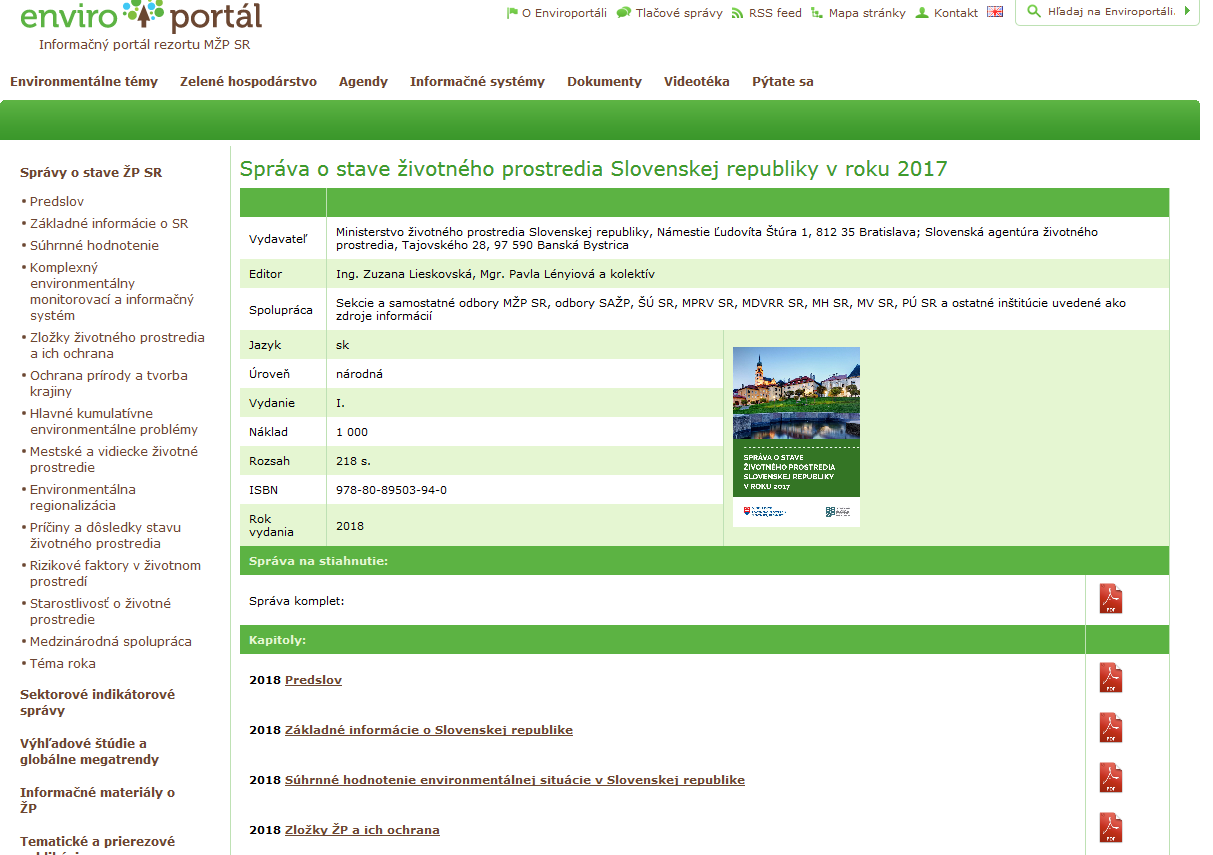
SOER is published annually in printed form in the range of about 200 pages and 1,000 copies. It is also published on the information portal on the environment, which is operated by SEA – Enviroportál. It allows the SOER to be accessible to the general public, where it is possible to find all versions of the SOER since the first published for the period 1992 – 1993. On the Enviroportál you can find the full text of the report in .pdf format, as well as a breakdown by chapter to facilitate targeted search for individual parts of the SOER. A shortened version in English is published non-periodically.

Objective:Publication of information on the issue of SOER, its distribution.
Output: Published information, distribution of a printed version of the report

An essential part of the SOER creation process is the process of its spreading among individual target groups, including the public. It is advisable to prepare a communication plan as individual subjects will be addressed. When designing forms of their addressing, it is necessary to take into account their specificities and to choose appropriate forms of their addressing. It is also very useful to create a space for feedback from SOER users to the assessment results. It is important for users to be aware of this option and it is therefore advisable to inform about it in the SOER release information.

Example for Slovakia:

Example of how to distribute SOER and publish information about its release

In order to distribute the printed version of the SOER, the SEA draws up a proposal for a distribution list, which is approved by the MoE. Subsequently, the SOER is distributed to the subjects defined in the distribution list.

For the purpose of publishing information on its issue, the following forms are used:

  • Press conference of the Minister of the Environment with media representatives
  • Discussion on the radio to present the main findings of SOER
  • Press release on the web pages of the Ministry of the Environment of the Slovak Republic, SEA, Enviroportál, social media
  • Information/articles in selected periodicals (magazines Enviromagazín, Životné prostredie)
  • Discussions at schools (colleges, secondary schools) aimed at presenting SOER results in connection with direct impacts on individuals
  • Processing of leaflets on SOER issue.

Example of the content of information published on the web pages of the MoE SR and SEA regarding SOER issue:


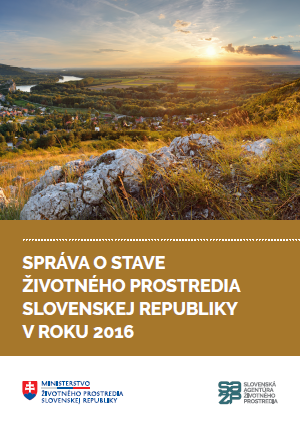
The Report on the State of the Environment of the Slovak Republic in 2016 was published


The submitted Report on the State of the Environment of the Slovak Republic in 2016 informs and evaluates the state of the environment in Slovakia and in which areas there are positive changes. It also describes areas with a number of identified challenges for taking and implementing the necessary measures. Attention is also paid to the evaluation of the results achieved during the fulfilment of tasks resulting from the Presidency of Slovakia in the Council of the European Union in the area of environmental care. The “theme of the year” was the evaluation of the current situation in the area of transition to circular economy.


The publication is issued annually by the Ministry of the Environment of the Slovak Republic in cooperation with the Slovak Environmental Agency in accordance with Law no. 17/1992 Coll. on the environment. It is thus contributed to the fulfilment of the constitutional right of Slovak citizens to quality and timely information on the environment.


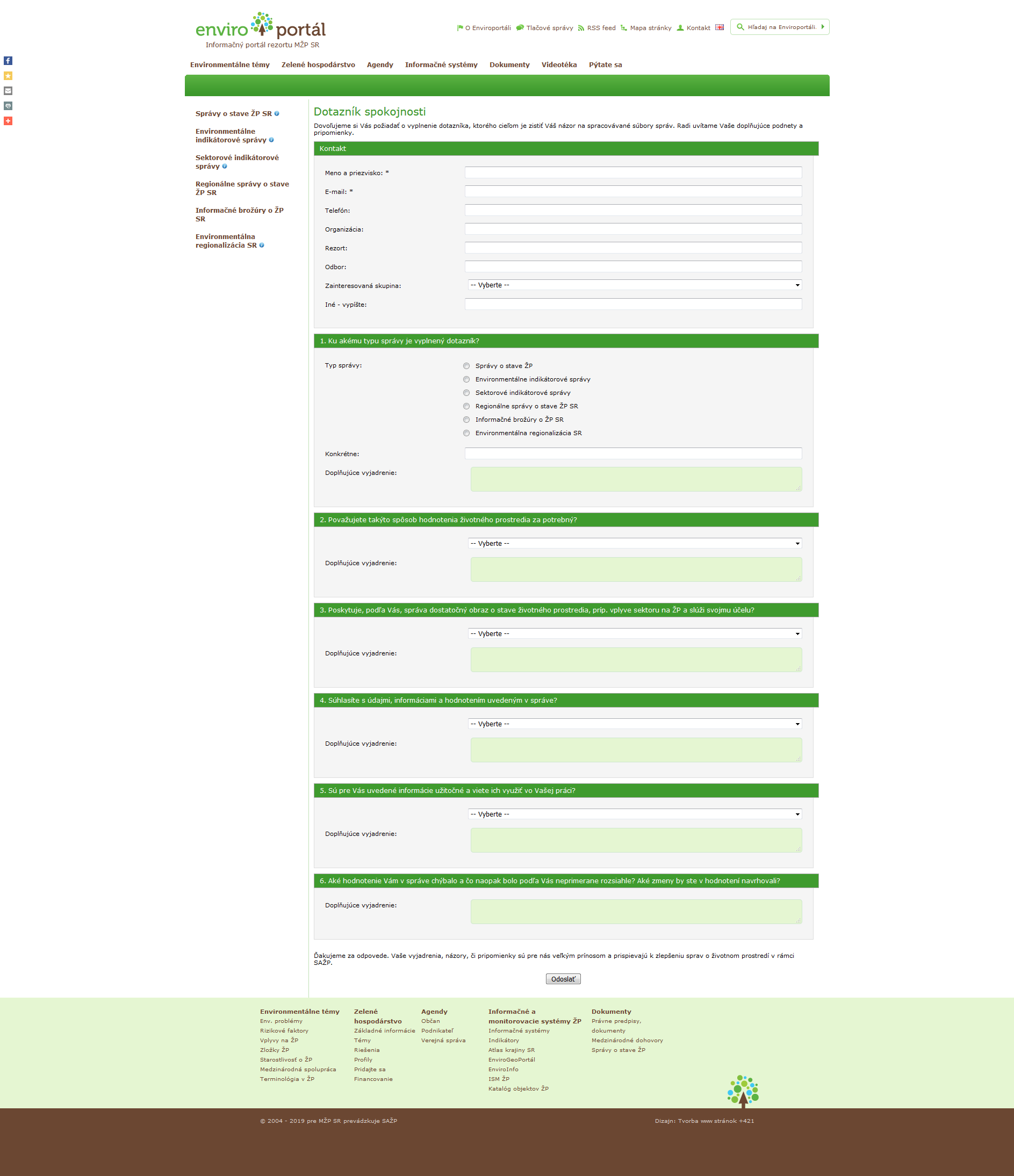
The publication can be found at https://www.enviroportal.sk/spravy/kat21, where a questionnaire for sending feedback and suggestions to the SOER team is also available.


In order to get feedback from the SOER users within the Enviroportál, the so called Satisfaction questionnaire is available on-line. Anyone can fill it in and send it, but the author of the answer must enter his or her contact details. This is also due to the fact that the team of authors responds to the questionnaires and, if necessary, actively communicates with the authors of the answers.

Example of the content of the satisfaction questionnaire used in Slovakia:

CONTACT


You can contact the helpdesk with your request and our experts on SOE report will make sure to get back to you